King's College London: Cells' 'timing' secret could unlock cancer and fibrosis cures
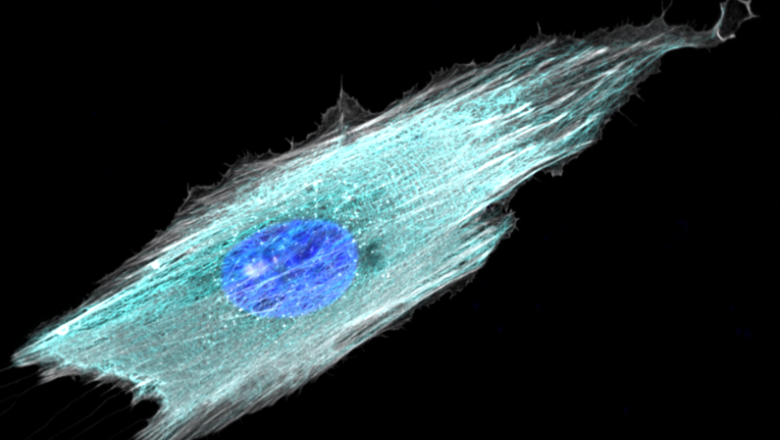
Imagine your body's cells are like tiny decision-makers. For years, scientists knew they reacted to physical forces, but now researchers at King’s College London have discovered they don't just sense these forces, they actually measure how long they last before acting. This could be a game-changer for treating serious conditions like cancer and fibrosis.
Cells are Smarter Than We Thought
The groundbreaking study, led by King’s College London and the Institute for Bioengineering of Catalonia (IBEC), reveals a crucial timing mechanism. Cells can ignore brief mechanical nudges but will react to sustained changes. This is vital because many diseases, including cancer and fibrosis, involve long-term shifts in tissue stiffness and mechanical forces.
The 'Low-Pass Filter' Analogy
Professor Pere Roca-Cusachs, a senior author on the work, explained the concept using a relatable example. "Imagine you’re driving on a motorway and hear a loud noise next to you. Likely, you’ll react immediately because it could be dangerous. But if you hear a small, unusual sound from your own engine, you might ignore it unless it persists for some time. Cells face a similar challenge – they need to decide which signals matter, and when to respond to them.”
How Cells Hold Onto Signals
The team found that cells use special contact points called fibrillar adhesions to grip their surroundings. These structures help 'hold' the cell's nucleus in a deformed state even after the force stops. This signal can persist for about an hour, thanks to a network of fibres called vimentin.
A Filter for Survival
This mechanism acts like a biological filter. Short forces are dismissed, but longer ones trigger a response. This is important for processes like the activity of the cancer-linked protein YAP.
Future Treatments on the Horizon
Dr Amy Beedle, a lecturer at King’s and lead author, highlighted the significance. "This work has huge implications for not just how cells and tissues function, but this temporal element, which we’re amongst the first to examine, is big for the future of treatment." She added, "Many diseases, including cancer and fibrosis, involve long-term changes in tissue stiffness and mechanical forces. Understanding how cells interpret how these complex mechanical signals are playing a part in disease progression could empower researchers to design better therapies in the future.”
Protecting Cells from Stress
The findings also suggest this timing mechanism helps protect the cell's nucleus from damage when under physical stress. Researchers are now keen to explore this further in complex tissues and disease settings.
Related Content
MORE: King's College London scientists map cancer drugs inside living cells — https://southlondonnews.com/2026/04/17/kings-college-london-scientists-map-cancer-drugs-inside-living-cells/
MORE: King's College London: Power cuts could spark mass heat deaths in Gulf — https://southlondonnews.com/2026/04/08/kings-college-london-power-cuts-could-spark-mass-heat-deaths-in-gulf/
MORE: King's College London: Your recycling could be making climate change WORSE — https://southlondonnews.com/2026/04/29/kings-college-london-your-recycling-could-be-making-climate-change-worse/
OFFICIAL SOURCE VERIFICATION:
This report is based on official data from King's College London.
Document: How cells decide when to react could shape future treatments for cancer and fibrosis | King's College London
Source Link: https://www.kcl.ac.uk/news/how-cells-decide-when-to-react-could-shape-future-treatments-for-cancer-and-fibrosis
Author




Subscribe for $2 every four weeks for the first six months
Subscribe for $20 every four weeks for the first six months